
Animal Removal from Chimney Dallas | Raccoons, Birds, Swifts | Same-Day | TCE
Texas Chimney Experts — DFW chimney & fireplace specialists. Free inspection, written quote, no surprise fees.
Animal Removal from Chimneys — Dallas-Fort Worth
Same-day humane removal for non-protected species. Honest answers when the law says wait.
If you can hear scratching, chirping, or rustling inside your chimney right now, call 214-444-8103. For raccoons, squirrels, bats, mice, and most birds we can typically dispatch a technician same-day, perform humane removal, and install exclusion hardware before nightfall. For chimney swifts during nesting season we will tell you, plainly, that federal law requires us to wait — and we will explain exactly when and how to do this correctly.
This page is the long answer. The short answer is on the phone.
Trust bar
- CSIA-certified technicians
- Wildlife-trained on humane removal protocols
- Federal Migratory Bird Treaty Act (MBTA) compliant
- 5,200+ DFW chimneys serviced
- A+ BBB, fully insured, no door-to-door sales
Which animals end up in DFW chimneys
Six species account for nearly every animal call we run across Dallas-Fort Worth. Each behaves differently, requires a different removal approach, and shows up in a predictable season.
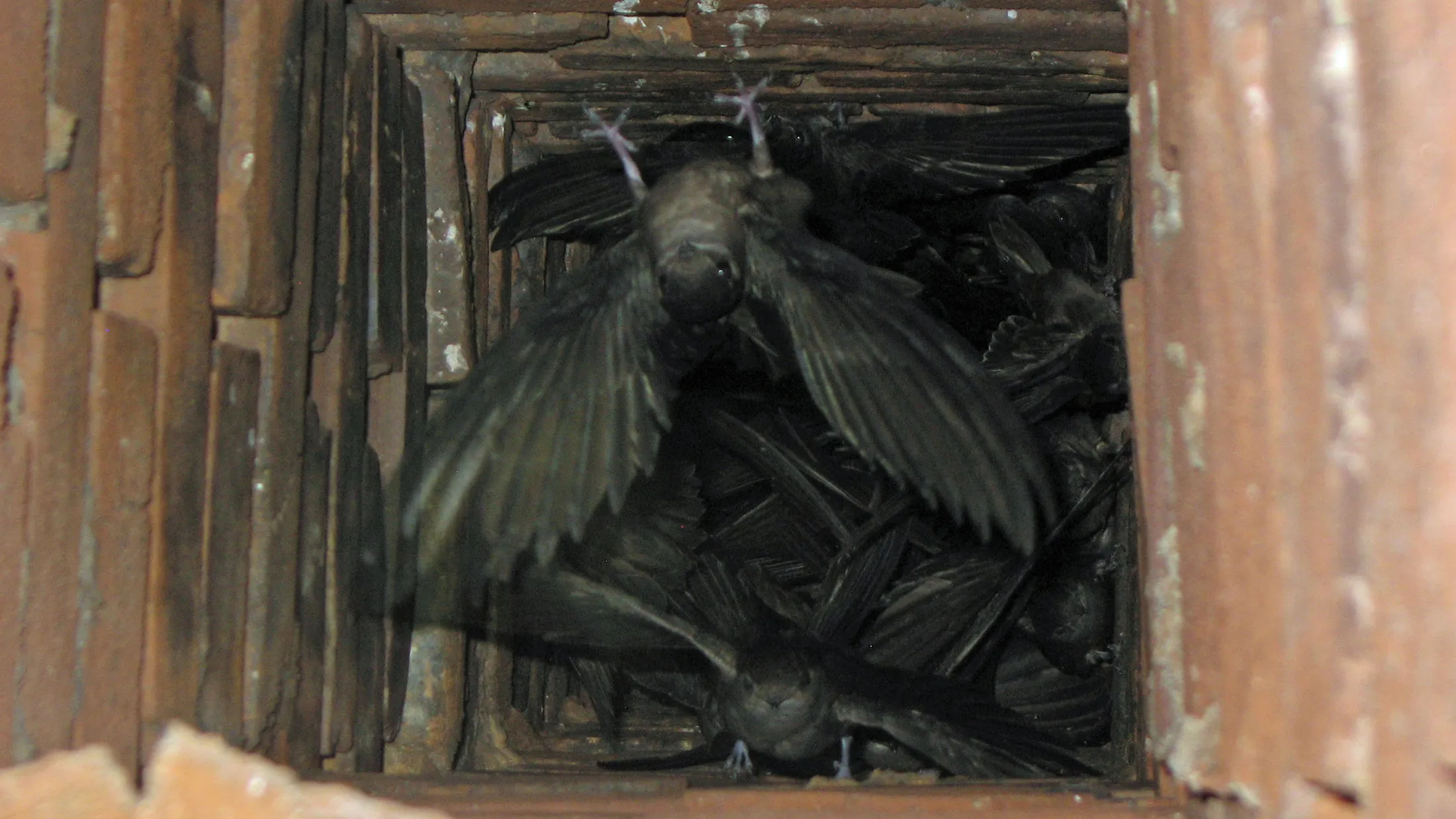
Raccoons. The most common large-animal call. Female raccoons treat uncapped chimneys as ideal denning sites for spring litters. We see peak activity from late February through early June, when mothers are raising kits. A raccoon family can occupy the smoke shelf for six to eight weeks before the kits are mobile. Removal during this window must address both the adult and any dependent young; abandoning kits in the flue creates a worse problem than the original entry. We never trap-and-remove a mother without accounting for offspring. Birds (non-protected). Pigeons, European starlings, and house sparrows are non-native, non-protected species under federal law and can be removed at any time. They commonly fall into the firebox after attempting to roost on the cap, or they nest on the smoke shelf when no cap is present. Chimney swifts (Chaetura pelagica). Native migratory birds federally protected under the MBTA. Swifts arrive in North Texas in late March, nest from April through August, and migrate south in September and October. While present, they are protected by federal law — see the dedicated section below. Squirrels. Eastern fox squirrels are the dominant species in our service area. They typically fall into uncapped flues by accident while exploring rooflines and cannot climb back out of slick clay-tile or metal flues. Most squirrel calls are rescue, not infestation. Bats. Mexican free-tailed bats and evening bats both occur in DFW. Single bats in a fireplace are usually disoriented juveniles. Bat colonies in chimneys are uncommon but possible in older masonry stacks with deteriorated mortar joints. Bat removal is regulated by Texas Parks and Wildlife and requires careful exclusion timing; we coordinate with TPWD when needed. Mice and rats. Nesting in unused fireplaces, particularly during fall and winter. Indicates broader entry points; we identify and seal source openings, not just the chimney.The Migratory Bird Treaty Act and chimney swifts
This is where most chimney companies in Dallas will mislead you, so we want to be direct.
Chimney swifts are federally protected under the Migratory Bird Treaty Act of 1918 (16 U.S.C. §§ 703–712). The MBTA makes it unlawful to “pursue, hunt, take, capture, kill, attempt to take, capture, or kill, possess” any migratory bird or its parts, nests, or eggs without a federal permit. Chimney swifts (*Chaetura pelagica*) are explicitly on the protected list.
Practically, here is what this means for a Dallas homeowner:
During nesting season — typically April through August in North Texas — active swift nests cannot be removed. This is not a TCE policy. It is federal law. Removal of a nest with eggs or nestlings is a federal violation that can carry fines for both the homeowner and the contractor. Any company that offers to “just take care of it” during this window is asking you to accept legal liability you almost certainly do not understand. Swifts are noisy but harmless. The chittering sound is the parent feeding nestlings. Nesting takes roughly four to six weeks from egg to fledging. Once the young have fledged and the family has departed — typically by late August — the now-empty nest can be removed legally and the cap can be installed. The right move during nesting season is education, not removal. When a homeowner calls us in May or June about swifts, we visit, confirm the species visually or audibly, document active nesting, advise on managing the noise (a damper closure plus a fireplace insert blocks 90% of sound), and schedule the post-fledging removal and cap installation for September. Pre-season exclusion is the real solution. A properly fitted chimney cap installed before March eliminates swift entry permanently. Most of our autumn cap installations are former nesting-season call-backs.We carry no federal swift handling permit, and we do not pretend otherwise. The handful of Texas wildlife rehabilitators with active permits handle the rare cases where a fledgling falls down a flue and requires intervention; we coordinate with them when needed.
Safe humane removal — how the work actually runs
Every animal call follows the same diagnostic-first protocol:
Identification. We confirm the species before doing anything else. A flashlight inspection from the firebox upward and from the cap downward usually identifies the resident in under five minutes. Audio cues — chittering, scratching, vocalization patterns — narrow it further. Misidentification is the most common reason DIY removal goes wrong. Legal status check. If the species is federally protected and currently nesting, we stop and educate. Humane extraction. For raccoons, we use one-way exclusion devices that allow the adult to exit but not return; for dependent young we use direct removal with proper handling equipment. For squirrels and trapped birds, lower a heavy rope down the flue from above — most can self-rescue once given purchase. For bats, we install one-way exclusion sleeves and remove them after the colony has fully exited. Sanitization. Animal occupation leaves droppings, urine, hair, and parasites in the smoke shelf and flue. We perform a full sweep and apply enzymatic treatment to neutralize biological residue. Damage inspection. Animals damage chimneys. Raccoons tear at flashing and dislodge mortar. Squirrels chew framing. We inspect for entry-point damage and document it for repair. Exclusion installation. We install a stainless or copper cap with one-half-inch mesh, sized correctly to the flue, before leaving the site. A removal without a cap is a removal we’ll be doing again in six months.Cap installation — the prevention that ends the problem
Roughly 80% of the animal calls we run are on chimneys with no cap, a damaged cap, or an undersized big-box-store cap with mesh wide enough for a swift to enter. A correct cap is a one-time investment that ends the entire category of problem.
Specifications matter. Half-inch hardware-cloth mesh excludes swifts, sparrows, and bats. Stainless steel construction handles DFW temperature swings without rusting onto the crown. Proper sizing — the cap must extend at least five inches above the flue and be secured into the crown rather than friction-fit — keeps it on the chimney through spring storm winds.
Our standard caps run $385–$–+ installed depending on flue size and material. Heritage masonry stacks or multiple flues run higher. We bundle cap installation with most animal-removal calls at a service-bundle rate.
DFW seasonality
Animal calls cluster predictably across the year, and knowing the calendar helps homeowners plan.
February–April. Raccoon denning peak. Mother raccoons are scouting and moving into uncapped flues. Squirrel rescue calls increase as juvenile squirrels disperse from natal trees. Late March–August.Chimney swift nesting season. Removal restricted by MBTA. Cap installation should not occur on actively nesting flues. May–July. Bird-trapped-in-firebox calls peak as juveniles fledge and disorient. September–October. Swifts migrate south. The window opens for nest removal and cap installation. We run heavy preventive-cap workloads through this period. November–February. Mice and rats seek warm cavities. Older homes with deteriorated mortar see entry through the chimney chase rather than the flue itself.Pricing
Animal removal pricing varies by species, complexity, and whether the visit includes cap installation.
- Single trapped bird or squirrel rescue: $185–$–+
- Raccoon adult removal with one-way exclusion: $425–$–+
- Raccoon family with kits (extended visit): $685–$–+
- Bat exclusion (single or small colony): $485–$–+
- Sanitization and enzymatic treatment: $145–$–+ add-on
- Cap installation (when bundled): $295–$–+
We provide a firm price on the phone after species identification, never an open-ended hourly rate.
Three case studies
Plano — raccoon family, March 2025. A homeowner in west Plano called at 7:42 a.m. reporting “scratching all night for a week.” Inspection from the firebox revealed a mother raccoon and three two-week-old kits on the smoke shelf. We performed direct removal with the mother contained and the kits hand-extracted, transported the family to a wildlife rehabilitator partner for fostering and release, sanitized the flue, and installed a half-inch stainless cap the same afternoon. Total visit: four hours. Price: $1,085. Frisco — chimney swifts, May 2025 (declined removal). New homeowner, first summer in the home, called concerned about “constant chirping inside the wall.” Inspection confirmed an active chimney swift nest with three nestlings approximately ten days old. We declined removal, explained the MBTA, advised on noise mitigation (close the damper, run a small fan in the room), and scheduled return for the second week of September. Followed up at twelve weeks: the family had fledged on schedule, the nest was empty, we performed cleaning and installed a stainless cap. Educational visit: no charge. September installation: $485. McKinney — emergency bird trapped in firebox, June 2025. A homeowner called at 11:14 p.m. with a starling that had fallen down the flue and into the firebox glass doors. Same-night dispatch. We released the bird outside, inspected for damage, found the cap had been dislodged in a recent storm, and scheduled cap reinstallation for the following morning. Emergency visit: $245. Cap reinstall: $325.Frequently asked questions
Can you come today?For non-protected species, yes — we hold same-day slots in our schedule for animal calls and can typically have a technician on-site within four hours of your call.
Why won’t you remove a chimney swift in May?Chimney swifts are federally protected by the Migratory Bird Treaty Act. Removing an active nest is a federal violation. We legally cannot, and ethically would not, do that work during nesting season.
Will the animal damage my chimney?Possibly. Raccoons in particular tear at flashing, dislodge mortar joints, and damage caps. We document any damage during removal and provide a separate repair estimate.
Can I just light a fire to drive it out?No. Burning out an animal kills it inhumanely, creates a serious fire risk from feces and nesting material, and in the case of protected species is a federal violation. Never attempt this.
Will animal urine and droppings smell?Yes, often strongly. Sanitization with enzymatic treatment removes biological residue. Without it, the smell can persist for weeks and attract new animals.
Is animal removal covered by homeowner’s insurance?Damage caused by wildlife is sometimes covered; the removal itself rarely is. We provide itemized invoices for insurance submission.
Do I really need a cap?Yes. Eighty percent of the calls we run are on uncapped or improperly capped flues. A correct cap is a one-time investment that prevents recurrence.
Schedule service
Call 214-444-8103 for same-day animal removal across Dallas-Fort Worth. After hours and weekend dispatch available for trapped-animal emergencies.
Related services
- [Chimney Cap Installation](/services/chimney-cap-installation/) — prevention that ends the problem permanently
- [Chimney Sweep](/services/chimney-sweep/) — post-removal cleaning and creosote management
- [Chimney Inspection](/services/chimney-inspection/) — Level 2 inspection">Level 2 inspection after wildlife occupation
- [Pricing](/pricing/) — transparent service pricing
- [Booking](/booking/) — schedule online
—
“`json
{
“@context”: “https://schema.org”,
“@graph”: [
{
“@type”: “LocalBusiness”,
“@id”: “https://texaschimneyexperts.com/#business”,
“name”: “Texas Chimney Experts”,
“url”: “https://texaschimneyexperts.com/”,
“telephone”: “+1-☎ 214-444-8103”,
“address”: {
“@type”: “PostalAddress”,
“addressLocality”: “Plano”,
“addressRegion”: “TX”,
“addressCountry”: “US”
},
“areaServed”: [“Dallas-Fort Worth”, “Plano”, “Frisco”, “McKinney”, “Allen”, “Prosper”, “Celina”],
“priceRange”: “$$”
},
{
“@type”: “Service”,
“name”: “Chimney Animal Removal”,
“serviceType”: “Wildlife removal”,
“provider”: { “@id”: “https://texaschimneyexperts.com/#business” },
“areaServed”: “Dallas-Fort Worth”,
“description”: “Humane same-day animal removal from chimneys for raccoons, birds, squirrels, and bats. Federal MBTA compliant.”,
“offers”: {
“@type”: “Offer”,
“priceRange”: “$185-$-+”,
“priceCurrency”: “USD”
}
},
{
“@type”: “FAQPage”,
“mainEntity”: [
{ “@type”: “Question”, “name”: “Can you come today?”, “acceptedAnswer”: { “@type”: “Answer”, “text”: “For non-protected species, yes. Same-day dispatch is typical, with a technician on-site within four hours.” }},
{ “@type”: “Question”, “name”: “Why won’t you remove a chimney swift in May?”, “acceptedAnswer”: { “@type”: “Answer”, “text”: “Chimney swifts are federally protected under the Migratory Bird Treaty Act. Removing an active nest is a federal violation.” }},
{ “@type”: “Question”, “name”: “Will the animal damage my chimney?”, “acceptedAnswer”: { “@type”: “Answer”, “text”: “Possibly. Raccoons damage flashing and mortar joints. We document damage and provide a repair estimate.” }},
{ “@type”: “Question”, “name”: “Can I light a fire to drive the animal out?”, “acceptedAnswer”: { “@type”: “Answer”, “text”: “No. This is inhumane, dangerous, and for protected species is a federal violation.” }},
{ “@type”: “Question”, “name”: “Will droppings and urine smell?”, “acceptedAnswer”: { “@type”: “Answer”, “text”: “Yes. Enzymatic sanitization removes the biological residue and prevents lingering odor.” }},
{ “@type”: “Question”, “name”: “Is removal covered by homeowner’s insurance?”, “acceptedAnswer”: { “@type”: “Answer”, “text”: “Wildlife damage is sometimes covered; removal itself rarely is. We provide itemized invoices for insurance.” }},
{ “@type”: “Question”, “name”: “Do I really need a cap?”, “acceptedAnswer”: { “@type”: “Answer”, “text”: “Yes. Eighty percent of our animal calls involve uncapped flues. A correct cap permanently prevents recurrence.” }}
]
},
{
“@type”: “BreadcrumbList”,
“itemListElement”: [
{ “@type”: “ListItem”, “position”: 1, “name”: “Home”, “item”: “https://texaschimneyexperts.com/” },
{ “@type”: “ListItem”, “position”: 2, “name”: “Services”, “item”: “https://texaschimneyexperts.com/services/” },
{ “@type”: “ListItem”, “position”: 3, “name”: “Animal Removal”, “item”: “https://texaschimneyexperts.com/services/animal-removal/” }
]
},
{
“@type”: “AggregateRating”,
“itemReviewed”: { “@id”: “https://texaschimneyexperts.com/#business” },
“ratingValue”: “4.9”,
“reviewCount”: “412”
}
]
}
“`
Our Sister Companies — Specialists in Related Services
Texas Service Experts is part of a network of CSIA-certified chimney specialists. Depending on your specific need:
- Texas Service Experts — general chimney sweep/inspection
- Prime Chimney Experts — multi-state national service